Mathias Driesse
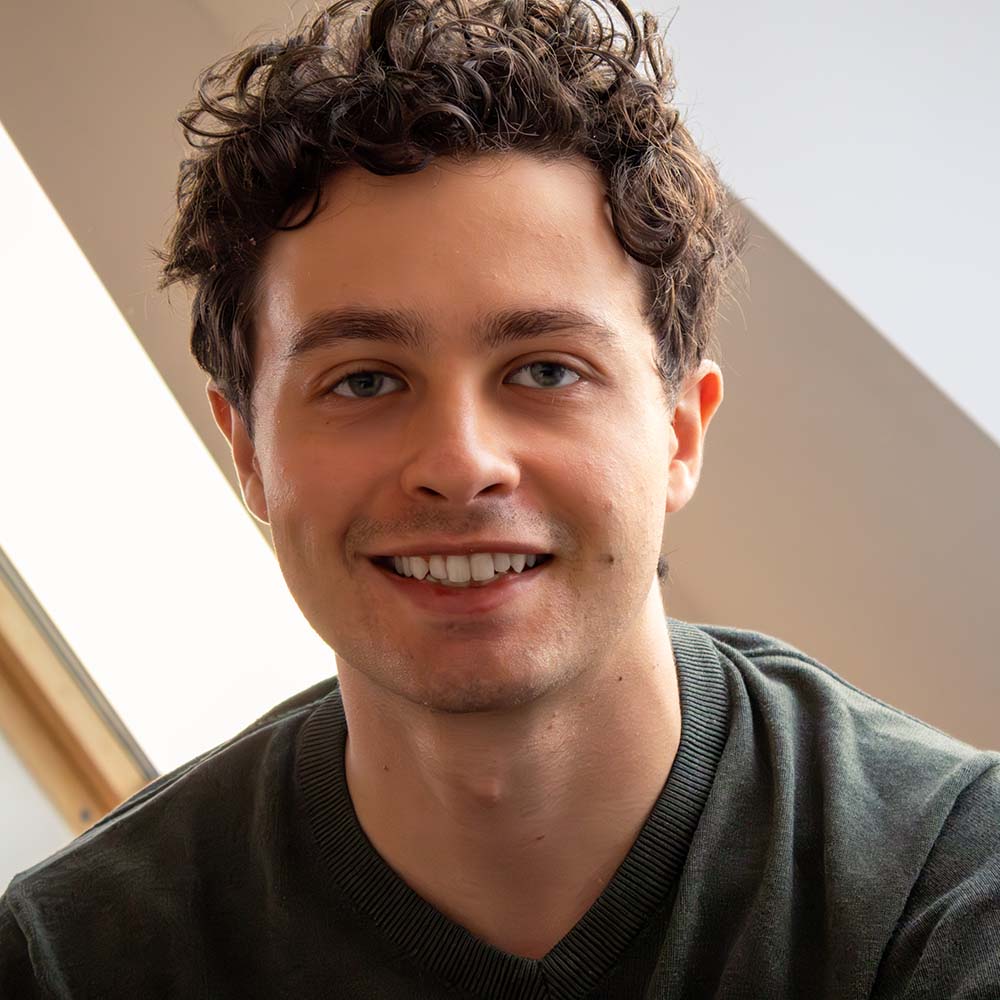
I'm Mathias, and I'm a PhD student in theoretical physics with the Plefka group, Humboldt-Universität zu Berlin at Humboldt-Universität zu Berlin. I mainly work on gravitational wave physics, but by importing tools from quantum field theory to solve my problems. Previously, I was at the University of Edinburgh and Caltech.
I also work on machine learning for physics, outreach , and in my spare time love hiking, running, cooking and photography , bouldering, reading, surfing, and films.
News
All news →- Jun 29, 2026
Around five months after my last paper, and after a long bug hunt, it’s time for the continuation of last time’s results in Gravitational wave scattering at O(G^4): Murua construction and elliptics. Here we pushed our calculations of gravitational wave scattering to one order higher, which means three loops total. We found two new things in particular. Firstly, in order to match to black hole perturbation theory, we had to construct an object called a Magnusian. We already knew this, but this time, we constructed it particularly efficiently using so-called Murua coefficients. Secondly, we found integrals that corresponded to an elliptic geometry, which required some extra cleverness to solve. I’m not sure there’s a physical meaning behind this, but I found it interesting nevertheless. The next stop will probably be adding spin to our calculations.
- Feb 5, 2026
After getting no papers out in 2025, it’s time for my second paper of 2026 already, Gravitational Wave Scattering in Spinless WQFT. This is on a slightly different topic, something which goes by the name of “gravitational wave scattering”, “Compton scattering” or “Raman scattering”, depending on who you ask. I played a much bigger role in this one and it sets the stage for some more high-loop computations that I’ll be running almost entirely on my own.
- Jan 22, 2026
We have another paper out, Conservative Black Hole Scattering at Fifth Post-Minkowskian and Second Self-Force Order! The title is almost identical to my first paper, except we switched out first for second. That makes a huge difference. I’ll post an explainer about the self-force expansion later on, but short story of the whole thing is that we found some really peculiar troubles in defining “conservative” that went unnoticed by our rival group at UCLA. Very exciting!
Selected publications
All publications →-
Gravitational wave scattering at O(G^4): Murua construction and elliptics
-
Gravitational Wave Scattering in Spinless WQFT
-
Conservative Black Hole Scattering at Fifth Post-Minkowskian and Second Self-Force Order
-
Emergence of Calabi–Yau manifolds in high-precision black-hole scattering
-
Conservative Black Hole Scattering at Fifth Post-Minkowskian and First Self-Force Order
Contact
- mathias.driesse@physik.hu-berlin.de
- Office
- Office 1.219, IRIS Adlershof
Zum Großen Windkanal 2, 12489 Berlin - InspireHEP
- https://inspirehep.net/authors/2768322
- ORCID
- https://orcid.org/0000-0002-3983-5852